Showing posts with label Dale Earnhardt Jr. Show all posts

Wednesday, October 3, 2012

My First Monster Mile

Welcome to the Route 30 Detour! US Route 30 intersects at I-95 in Philadelphia and goes from coast to coast, including passing through Pittsburgh and the home of Drexel University SMT student and blog contributor, Bryan Fyalkowski (@fyalkowski)...


I attended my first NASCAR race this past Sunday (Sept. 30, 2012); the AAA 400 at Dover International Speedway. Since I began to "follow" the sport a few years ago, my interest, knowledge and curiosity in it has grown tremendously. When my roommate, a rare (or so I thought) northern NASCAR fan, had an extra ticket for me, I jumped at the opportunity to join him.

When he told me he wanted to get to the track around 10am for the 2:15pm race, I was not necessarily in favor because it meant we would have to leave Philadelphia at 8am on a Sunday morning. When we arrived, however, I realized I was in for a very unique and fun experience.

Outside of DIS, which was probably the most gargantuan sporting venue I have ever seen, there was a carnival-esque setup that stretched for about a mile. If you want to see a clinic on sponsorship activation, I suggest you attend the next available NASCAR race.


First of all, DIS has a huge structure of the Monster Mile mascot outside of the entrance with past winners' names etched into plaques that are placed around the bottom. A few hours before the race, Brian Dawkins, who was serving as the grand marshal (guy who says: "Gentlemen, start your engines!"), did an interview right below the statue.


The SPEED channel set up a stage with the four analysts around a desk with the crazed fans in the background waving their arms and their own signs. The signs had big Sunoco (the Official Fuel of NASCAR) logos on them and could be created at a booth just across the way.

Chevrolet had a big area with Dale Earnhardt, Jr.'s #88 National Guard car and Kevin Harvick's #29 Budweiser car. They had a new Challenger and a square table with computers set up to input your name and contact information to receive a free t-shirt.


Sprint set up an area where you could take a picture with the Sprint Cup and have it sent to your email. Meanwhile, there was an emcee on stage with the Miss Sprint Cup girls, throwing free caps to the fans who screamed the loudest.


AAA has to overcome people referring to the race just as the "Sprint Cup Series at Dover" and attempt to leave their footprint on an event for which they actually have the naming rights. AAA had a setup with the winner's trophy of the Monster Mile guy holding a Sprint Cup car in his hand. At one point, the people at the boot held a water balloon toss, where the winning pair received a hat and the losing participants got earplugs (which were absolutely necessary, by the way).

3M, sponsor of Greg Biffle's #16 Ford Fusion, set up an area and fans were lining up to receive free home supplies such as sponges, tape and post-it notes. 5-hour Energy, sponsor of Clint Bowyer's #15 Toyota Camry, was giving out free samples of their product and throwing them into a large crowd in front of their setup.

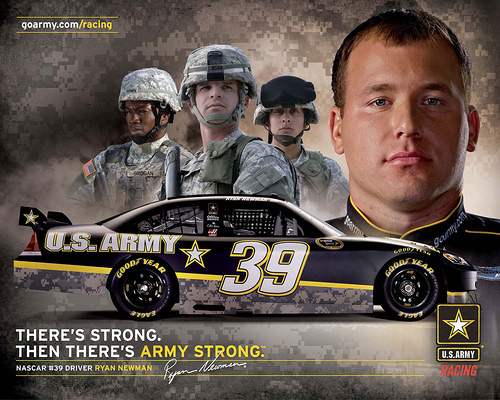
US Army, sponsor of Ryan Newman's #39 Chevrolet Impala, posted up with a hummer, a table with unloaded firearms and a man dressed up in mossy camouflage. Then, one of the soldiers began pumping up the crowd and asking his bud to shoot t-shirts out of his launcher at the loudest section of fans.
 
National Guard had an area where fans could see who could do the most push-ups as service men and women cheered them on. Anyone who did at least 20 got their choice of a water bottle or t-shirt, while other service men and women gave out #88 stickers, magnets and lanyards. My roommate did the push-ups while my fat ass got in line for the free stuff.

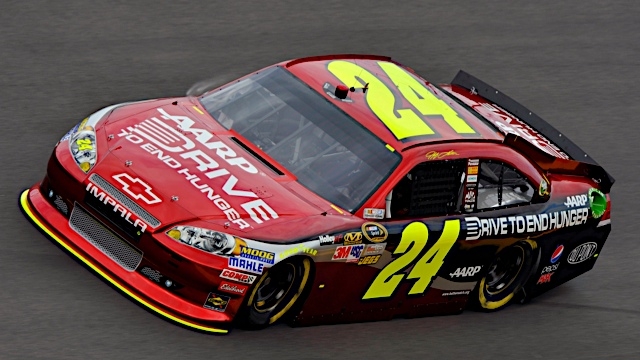
Drive to End Hunger, sponsor of Jeff Gordon's #24 Chevrolet Impala, set up a spot where they held a hourly trivia contest where five fans would answer questions about Gordon and senior hunger in the United States. The winner of the trivia would receive an autographed Gordon item while the losers would received Drive to End Hunger wristbands and drink koozies.

Not to mention, each driver worth rooting for (excluding guys like Dave Blaney, JJ Yeley, etc.) have their own truck in which their employees sell merchandise with their name and sponsor on them. Although drivers like Earnhardt, Gordon and Jimmie Johnson have the most crowds around their trucks, I found the most interesting tidbit from my visit to Brad Keselowski mobile headquarters.

Keselowski drives the (Blue Two) #2 Dodge Charger, sponsored by Miller Lite. While purchasing a t-shirt from his team's truck before the race (which Keselowski would ultimately win and jump to the front of the Sprint Cup standings in the process) I was asked to show my ID to the worker in the truck so I could buy a shirt with a Miller Lite logo.


NASCAR is a unique sport because a fan does not actually see his or her favorite driver during a race. The only thing a fan has to associate with a driver is the number of the car and its sponsor. Even with this huge obstacle, NASCAR drivers connect with their fans as well as any other sport, probably even better.

I witnessed this firsthand at Dover, where some drivers would actually come out to their sponsor's tents and have interviews just a few hours before the green flag. Juan Pablo Montoya came out to the Chevrolet area, Denny Hamlin had a brief interview in the FedEx tent, Mark Martin answered questions near the AAA setup and many more.

Since there are no timeouts, halftimes or breaks in the action during NASCAR races, sponsors have to be more creative with their activation during pre-race and post-race events. It is a highly sponsor-driven (no pun intended) business, but unlike any other sport.

 
As I said before, if you intend to be a sport professional and have never been to a NASCAR race, I highly suggest going at some point. You will get a one-of-a-kind experience you cannot get anywhere else.

Enjoy your trip back to I-95 and I'll see you next week!

Sunday, July 15, 2012

Dollars & Sense - Armed Forces Sponsorships


Last Thursday in his weekly Real Talk column, Seth asked me whether the dollars spent by the Armed Forces in sports sponsorships make sense.  Initially I was going to answer his question in the comments section, but it really got me thinking.  Do these really make sense?  Here is my attempt to explain what I think about these types of sponsorships. 

The Armed Forces, which for our purposes will include the Army, Navy, Air Force, and National Guard, is more or less funded by donations and tax payer dollars.  Tax payers, naturally, want to see their tax dollars spent wisely by their government.  It seems that much of the backlash over the Armed Forces buying sports sponsorships is that tax payers feel that sports sponsorships are not a wise way of spending tax dollars.  You can easily point out areas of tax dollar waste and inefficiency, but this is a sports business blog and frankly I’m not interested in anything pertaining to politics.  Anyhow, I think I speak for many when I say that the points of contention with these types of sponsorships are at least valid and worth looking into. 

As we all know, sports sponsorships ain’t cheap.  It is reported that the Army paid about $500,000 per race for their sponsorship of Ryan Newman’s car before they pulled their sponsorship last week (SBJ, 2010).  They sponsored Newman’s car for 15 races per year, which puts their total annual sponsorship tab around $7.5 million. And that’s just for one car!  Did I mention that sports sponsorships ain’t cheap?
Seth mentioned last Thursday that a lot of the issues raised with the Army’s sponsorship deals are that it lacks any tangible return on investment.  Do they really have a solid figure of how many new recruits that they are bringing in from this?  Do they have a dollar amount on new donation dollars coming in?  It’s tough stuff to measure, which I’m sure they have realized over the past few years.

The Armed Forces are just like any other business in that they have to get their brand name out there and they have to get people involved.  However, the Armed Forces face the challenge of trying to convince people to donate not only valuable time and money to their country, but possibly their life in the process.  That’s an element that many businesses do not face because consumer products and services typically are not actively taking lives.  The nature of the commitment to the Armed Forces naturally makes it difficult to get people involved. 

There is a strong stigma against the current war that we find ourselves engulfed in.  Even though the nation is in the process of pulling out, the stigma of the war seems to have been cast over the Armed Forces in general.  Patriotism is certainly not what it used to be.  We are not that “one nation under God” anymore.  We are a country of individuals.  It is tough to get people involved in risking their life for their country when they are simply living in the country.  These people aren’t “living” their country anymore.  It’s simply a different time with a different attitude and perception of the Armed Forces.

A point of the sponsorship that I think is tough for the Armed Forces is the activation of the sponsorship.  The activation can be a very sensitive subject.  The Armed Forces must be gentile in approaching people about enlisting.  It is inherently much different to be approached about buying a product than it is to risk your life.  People (hopefully) value their lives greatly, so having a government organization asking you to risk your life can be tricky.  The Armed Forces must tread lightly when it comes to activation.  The problem here is that any under-activated sponsorship is bound to fail at some point. 

Although the money spent on advertisements makes the tax payers cringe, it is a necessary bullet in the Armed Forces business plan (pun intended).  Whether they are spending money in sports or elsewhere, the dollars are inevitably going to be spent somewhere.  Clearly, the Armed Forces see what all other businesses and companies see in sports.  They see a passionate group of fans jumping at the chance to show their loyalty.  Completely understandable. 

The Sense

It is hard to make sense of this one.  The different divisions of the Armed Forces obviously feel the same way considering the Army recently pulled their NASCAR sponsorships and the National Guard said that they were sticking with Dale Earnhardt Jr.   
Sports sponsorships are expensive; there’s no secret about that.  Additional to the price tag of a basic sponsorship, the activation of the sponsorship costs big money.  Sometimes the quantity of activation can be a big question mark.  How are the Armed Forces supposed to hammer their message home to their target market, while also treading lightly as to not force government entities upon people?  The government and the Armed Forces already have a strong stigma that is weighted heavily against them, so over-activation could only alienate the people further.  With this much tip-toeing around how much activation is the right amount of activation, how in the world are they supposed to perfect the quality, innovation, and creativity of the activation.  It is close to impossible.

It is important to remember that if the money isn’t spent in sports, it will be spend somewhere else.  Sports sponsorships may not produce the tangible results that marketers, and in this case politicians, look for, but would another type of sponsorship offer a clearer outlook?  I would say that’s doubtful.   Sports sponsorships may be expensive, but there is proven reason.  Advertisers play off of the passion and loyalty shown by sports fans.  The Armed Forces is just trying to jump on the bandwagon.

Overall, I think there is still some sense in the Armed Forces spending their sponsorship dollars in sports.  Tax payers may see it differently, but there are plenty of other ways Barry Obama can waste your money so don’t take this one too personally.  It just happens to be a bit more visible.  Sports sponsorships may not be an exact science, but seriously what sponsorship is?  Regardless of tangible results, there is some kind of method to the sponsorship madness in sports.  Otherwise, there wouldn’t be the incredible demand that there is now. 
This may just be speculating or generalizing, but I feel that NASCAR is a good fit for the Armed Forces.  Typically NASCAR is a southern dominated sport, and stereotypically the south is further behind in the times which could make them more susceptible to being stuck in the American pride type ways. 

I think that given the sensitivity of the Armed Forces sponsoring anything, they have done a pretty good job in their approach.  Although they spend tax payer dollars, sports may be the best option for them because of the targeted audiences and passionate fan bases.  For now I say that the Armed Forces sports sponsorships make sense.  But the jury is out because after all, sponsorships aren’t an exact science.